

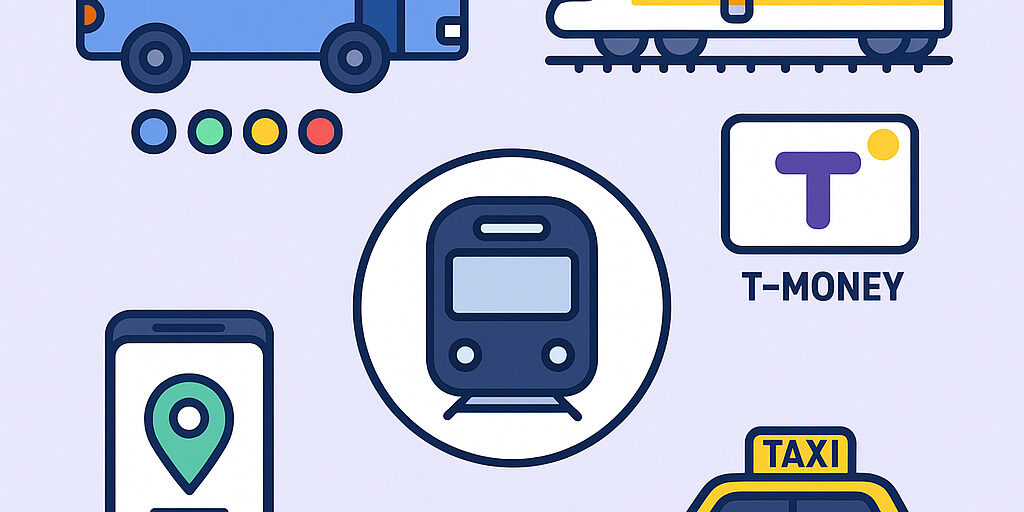
🚇 Transportation in South Korea — The Complete Guide
South Korea’s transport system is one of the most efficient in Asia — modern, affordable, and incredibly reliable. Whether you’re exploring Seoul’s vibrant neighborhoods or traveling across the country, here’s how to move around like a local.
🚌 Public Transport in Cities
Bus Colors and What They Mean
Seoul’s bus system is smartly color-coded so you can tell at a glance how far each bus goes:
| Color | Type | Description |
|---|---|---|
| Blue (간선버스) | Trunk / Mainline | Connects downtown Seoul with outer districts or suburban areas. |
| Green (지선버스) | Feeder | Short local routes linking neighborhoods to nearby subway stations. |
| Red (광역버스) | Express | Fast routes connecting Seoul to surrounding cities like Suwon, Ilsan, or Incheon. |
| Yellow (순환버스) | Circular | Loops within specific zones, ideal for short urban rides. |
All buses announce stops in both Korean and English. Always tap your T-Money card when entering and when exiting — if you forget to tap out, the system automatically charges the maximum fare.
🚇 Subway Network
Seoul’s subway is massive — over 23 lines covering Seoul, Incheon, and Gyeonggi Province. Trains run from about 5:30 a.m. to midnight. You’ll find bilingual signage, platform screens showing train times, and convenience stores at nearly every station.
- Core lines (1–9) run across the city and connect seamlessly with suburban lines.
- Lines such as AREX (airport), Gyeongui-Jungang, and Shinbundang link to outer regions.
- Peak hours: 7:30–9:30 a.m. and 6:00–8:00 p.m.
- Lines 2, 4, and 9 are famously crowded — plan accordingly.
Official info → Seoul Metro
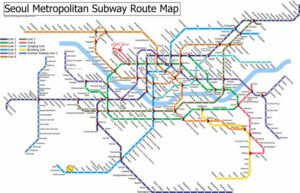
Subway map
💳 The T-Money Card
The T-Money card is your best friend for getting around Korea — one card for subways, buses, taxis, and even convenience stores.
Where to Buy
- At convenience stores (CU, GS25, 7-Eleven, Ministop, Emart24).
- Subway stations (vending machines and ticket counters).
- Airports (Incheon, Gimpo) at metro stations or tourist desks.
How to Recharge
- At convenience stores: hand your card and cash to the clerk and say “티머니 충전해주세요” (T-money chujeon haejuseyo — please recharge my T-Money).
- At top-up machines: select English, choose Recharge, insert cash (₩1 000–₩50 000), and tap your card. Machines accept cash only.
- The balance displays automatically when you scan at any gate.
💡 Always tap in and tap out — this applies to buses, subways, and even some express trains (KTX). Transfers within 30 minutes between bus ↔ subway ↔ bus are free or discounted.
Official site → tmoney.co.kr
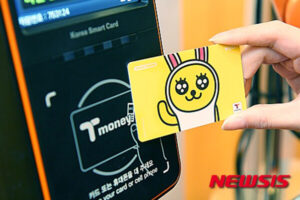
T-money
📱 Navigation & Transport Apps
| App | Language | Use |
|---|---|---|
| Naver Map | English / Korean | Most accurate for walking and detailed directions. Excellent for exit numbers and transfer paths. |
| KakaoMap | Korean | Great for café, restaurant, and bus searches. Less intuitive in English. |
| Citymapper (Seoul) | English | Integrates all modes and sends real-time notifications when to get off — perfect for non-Korean speakers. |
🧭 Note: Neither Naver Map nor KakaoMap offer stop alerts; only Citymapper does.
💡 Local Tips & Etiquette
Rush Hours & Timing
- Avoid 7:30–9:30 a.m. and 6:00–8:00 p.m., especially on busy lines.
- Subways and buses stop around midnight; after that, use night buses (marked N) or taxis.
Inside the Metro
- Stand on the right side of escalators; the left lane is for walking.
- Let passengers exit first.
- Yellow seats are reserved for the elderly and disabled.
- Pink seats are for pregnant women only — even if unoccupied.
- Keep your phone on silent and avoid calls.
Payment Habits
- Top-up small amounts (₩10 000–₩20 000) to stay flexible.
- Keep a few coins — some vending machines and lockers still require cash.
- Always scan your T-Money in and out to ensure correct fares and transfer discounts.
🚖 Taxis & Ride-Hailing
Taxis are safe, clean, and available 24/7.
- Regular Taxi – standard and affordable.
- Deluxe / Black Taxi – more space and comfort, higher price.
- Van Taxi – for groups or heavy luggage.
Apps
- Kakao T – most used by locals; requires Korean payment setup.
- K-Ride – ideal for foreign visitors; accepts international cards and offers English interface.
- Uber Korea – fully in English, reliable in Seoul and Busan.
💡 Look for the sign “빈차” (bin-cha) — it means “available.”
🚅 Intercity Travel
KTX – Korea Train Express
- Connects major cities like Seoul ↔ Busan (2 h 30) and Seoul ↔ Daegu (2 h).
- Book on Korail or through the Korail Talk App (English available).
- Arrive 15 minutes early, as gates close before departure.

KTX
SRT – Super Rapid Train
- Slightly cheaper; departs from Suseo Station (southern Seoul).
- Book via etk.srail.kr.
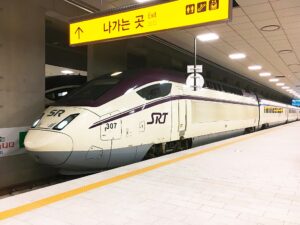
SRT
Express & Intercity Buses
- Express Bus (고속버스) – long-distance, minimal stops.
- Intercity Bus (시외버스) – regional routes with more stops.
- Reserve online at kobus.co.kr (English interface).
- Main Seoul terminals: Seoul Express Bus Terminal (south) and Dong Seoul Terminal (east).
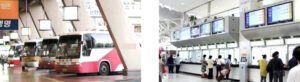
Seoul express bus terminal
✈️ Domestic Flights
For longer trips (Jeju, Busan, Ulsan), low-cost airlines like T’way Air, Jeju Air, and Air Busan offer quick flights under one hour. Search and compare fares on Naver Flights or Google Flights.
✨ Conclusion
From the neon glow of Seoul’s subways to the speed of the KTX, getting around South Korea is easy, efficient, and enjoyable. With a T-Money card, a few local apps, and a bit of etiquette, you’re ready to explore every corner of the country — stress-free.